


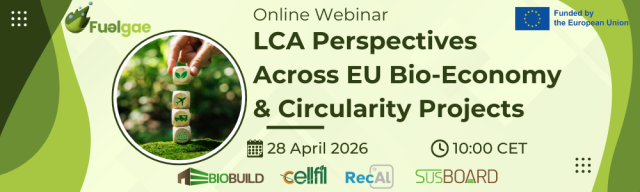
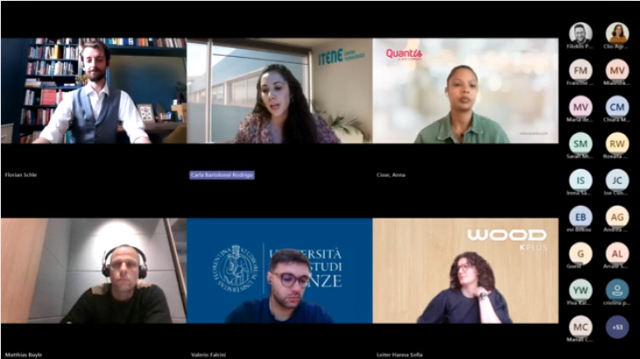
The recent FUELGAE webinar brought together researchers and innovation experts from across Europe around one question that sits at the heart of the green transition: how do we know whether a new bio-based or circular solution is truly more sustainable? The answer is life cycle assessment, or LCA. From advanced fuels and bio-based building materials to textiles, secondary aluminium and formaldehyde-free wood panels, the webinar showed that LCA is far more than a reporting exercise. It is a decision-making tool that helps projects identify hotspots, understand trade-offs, improve design choices and communicate credible sustainability benefits to industry, policy and research audiences.
If you missed the live session, you can watch the webinar recording below.
In this blog, we bring you a recap highlighting key takeaways from each project presentation and what they tell us about the growing role of LCA in Europe’s bioeconomy and circular economy landscape.
FUELGAE: Assessing microalgae-based fuels for hard-to-abate sectors
As host project, FUELGAE opened the webinar with an overview of its work on advanced microalgae-based fuel production. The presentation showed how LCA is being used to evaluate the environmental performance of biofuels produced from industrial CO2 streams, with case studies linked to a bioethanol plant and a steel plant. Early results suggest promising greenhouse gas reductions compared with conventional fossil fuels for aviation and maritime applications, while also making clear where further optimisation is needed. In particular, the photobioreactor stage emerged as a major hotspot due to nutrient demand and energy use. This is exactly where LCA proves its value: not simply in confirming impact reduction potential, but in identifying where innovation must focus next to make low-carbon fuels technically and economically viable.
BIOBUILD: Balancing material choices and energy performance in sustainable buildings
BIOBUILD shifted the discussion to the construction sector, where the project is developing bio-based wallboards and floor panels designed to improve both material sustainability and thermal energy performance. The presentation explored several binder options, including epoxidised linseed oil, lignosulfonates and mycelium-based approaches, and examined how these compare with conventional panel solutions. One of the most interesting insights was that sustainability gains do not depend on a single factor. Material substitution, indirect effects, manufacturing energy demand and building-level energy savings all matter. The project’s use of LCA alongside energy simulation underlined an important message for circular construction: better materials alone are not enough. Their benefits need to be understood in the context of how buildings actually perform in use.
CELLFIL: Tracking circularity opportunities across the textile value chain
In the textile sector, CELLFIL offered a valuable reminder that circularity must be assessed across the whole value chain, not just at the fiber stage. The project is working on bio-based filaments, including lyocell-based solutions that integrate recycled and alternative feedstocks such as orange-derived material. Its LCA work spans from filament production to end-use applications in areas such as performance apparel, automotive textiles and technical reinforcement materials. Although final results are still to come, the presentation clearly showed why LCA is essential in such a complex system. Different end uses require different functional units, assumptions and end-of-life considerations. In other words, the sustainability of a filament cannot be judged in isolation. It has to be measured in relation to how the material is processed, used and potentially recovered.
RecAL: Making LCA faster and more usable for design decisions
RecAL brought a different but highly relevant perspective by focusing on how LCA can be made more accessible to designers and engineers. The project is developing a rapid LCA tool to support early-stage decision-making, particularly in aluminium-related applications, through pre-characterised process archetypes and a structured data space. This approach addresses one of the biggest barriers to wider LCA use: complexity. If sustainability assessment remains too slow or too specialised, it risks arriving too late to influence design choices. RecAL’s contribution is therefore strategic. It shows that strengthening the circular economy is not only about better materials and processes, but also about better tools that allow sustainability to be built into innovation from the start.
SUSBOARD: Looking beyond environmental impacts in wood-based panels
The final presentation, from SUSBOARD, added another important dimension to the conversation by showing how sustainability assessment can extend beyond environmental indicators alone. The project is developing a fully bio-based, formaldehyde-free adhesive system for particleboards and MDF, while also integrating social life cycle assessment into its work. Early findings pointed to adhesive production as a major hotspot and highlighted the need to examine trade-offs carefully, especially when bio-based feedstocks may reduce climate impacts but increase pressures in areas such as eutrophication. The project’s methodology-focused presentation was a useful reminder that choices around system boundaries, functional units and impact assessment methods strongly shape results. For researchers, companies and policy audiences alike, that is a crucial lesson: robust sustainability claims depend on transparent and well-justified assessment choices.
Why LCA is central to bio-based and circular economy innovation
Across all five presentations, one message stood out: LCA plays a key role in any serious bio-based or circular economy project because it helps turn ambition into evidence. It can reveal whether a bio-based alternative really performs better than a fossil benchmark, where environmental hotspots remain, how circular strategies affect other impact categories and what trade-offs need to be managed before a solution can scale. It also helps projects communicate more clearly with industrial partners, investors and policy makers by linking sustainability claims to measurable results. In a policy context increasingly shaped by credible green claims, safe and sustainable by design principles and circular economy targets, this kind of evidence base is becoming indispensable.
Join the next FUELGAE event
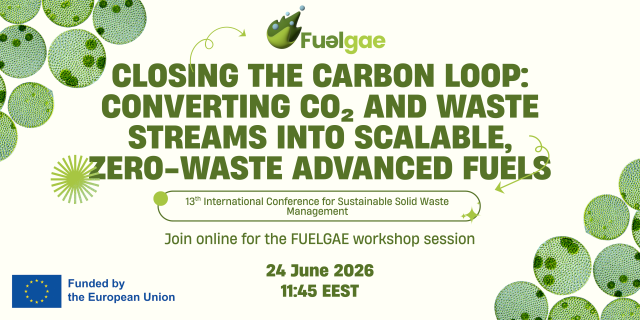
If this webinar confirmed anything, it is that cross-project dialogue is essential for moving sustainable innovation forward. By bringing together perspectives from fuels, buildings, textiles, materials and assessment tools, the FUELGAE webinar created a valuable space for shared learning across Europe’s research and innovation community. If you would like to continue the conversation, we invite you to register for the next FUELGAE event: a special workshop taking place within the 13th International Conference for Sustainable Solid Waste Management on 24th June at 11:45 EEST. The special session titled Closing the Carbon Loop: Converting CO₂ and Waste Streams into Scalable, Zero‑Waste Advanced Fuels will see presentations from the FUELGAE projects and other experts as well as a roundtable. You can join us online by registering here.


