


As the aviation industry faces increasing pressure to reduce its carbon footprint, Sustainable Aviation Fuel (SAF) has emerged as one of the most promising pathways toward decarbonization. Among the various feedstocks being explored, microalgae stand out due to their rapid growth rates, high lipid content, and ability to thrive in non-arable environments. However, producing SAF from microalgae remains an evolving process with significant environmental, economic, and technical uncertainties.
By evaluating the environmental impacts associated with every stage of production, LCA helps ensure that microalgae-based SAF delivers genuine sustainability benefits rather than shifting environmental burdens elsewhere.
What is Life Cycle Assessment (LCA)?
Life Cycle Assessment (LCA) is a systematic methodology used to evaluate the potential environmental impacts of a product, process, or service throughout its entire life cycle. In the case of microalgae-based SAF the stages considered include raw material extraction, cultivation and harvesting, processing and conversion, distribution, and use in combustion.
Here, LCA provides a comprehensive view of Greenhouse Gas (GHG) emissions, energy consumption, water use, and other environmental indicators across the entire value chain, helping to identify hotspots in the process, as well as areas for improvement to ensure the fuel’s overall sustainability.

How LCA Contributes to microalgae-Based SAF Production
Life Cycle Assessment (LCA) plays a crucial role in improving microalgae-based sustainable aviation fuel (SAF) by providing a comprehensive understanding of its potential environmental impacts across the entire production chain. It helps identify the stages and processes that contribute most significantly to these impacts, such as energy use in cultivation systems, nutrient inputs, harvesting, and fuel conversion. By highlighting these critical points, LCA enables stakeholders to target efforts where they will have the greatest environmental benefit.
In addition, LCA allows for the comparison of microalgae-based SAF with conventional fossil pathways. This comparative perspective helps researchers and industry decision-makers determine which approaches are the most efficient and sustainable under specific conditions. As a result, LCA supports informed choices that can guide both research directions and large-scale implementation strategies.
Beyond evaluation, LCA also contributes to technological optimization by enabling the assessment of alternative scenarios. For example, it can evaluate the benefits of integrating renewable energy into production, improving water and nutrient recycling systems, and making better use of co-products such as animal feed or fertilizers. These insights help engineers design more efficient and environmentally responsible systems from the early stages of development. Finally, LCA is essential for assessing whether microalgae-based SAF can deliver climate benefits and aligns with regulatory requirements. It quantifies greenhouse gas emissions across the full life cycle, helping verify compliance with emission reduction targets and supporting policy frameworks and certification schemes.
LCA in FUELGAE
The LCA that is being carried out in FUELGAE aims to assess the sustainability of biofuel production, specifically based on Case Study I (biogenic gas) and Case Study II (SAF). The products obtained in the project include advanced liquid biofuels (for aviation and maritime sectors), bioethanol, biochar and biomethane.
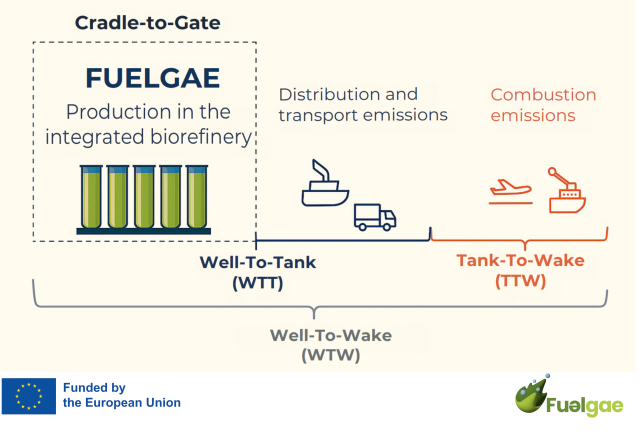
The environmental impact was calculated using SimaPro 9.6.0.1 software and the ecoinvent 3.11 database. A “Well-To-Wake (WTW)” (see figure above) system boundary was considered for the entire life cycle, which includes production, distribution and transport, as well as the combustion stage. The methodology used is CML-IA baseline methodology, a widely used LCA method that translates all emissions and resource uses of a product or process into standard environmental impact categories (like climate change or toxicity) so their overall environmental footprint can be easily understood and compared. Moreover, ITENE, leading the LCA work within FUELGAE, used IPCC 2021 GWP for Global Warming Potential (GWP) impact category, which measures how much different greenhouse gases contribute to climate change by comparing their heat‑trapping effect to CO₂ over a defined time period, using the latest climate science from the IPCC. The functional unit of this assessment is “Production of 1 MJ (MegaJoule) of biofuel as part of the integrated biorefinery’s yearly output”. Energy allocation was applied to the analysis to assign impacts based on the energy content of each product.
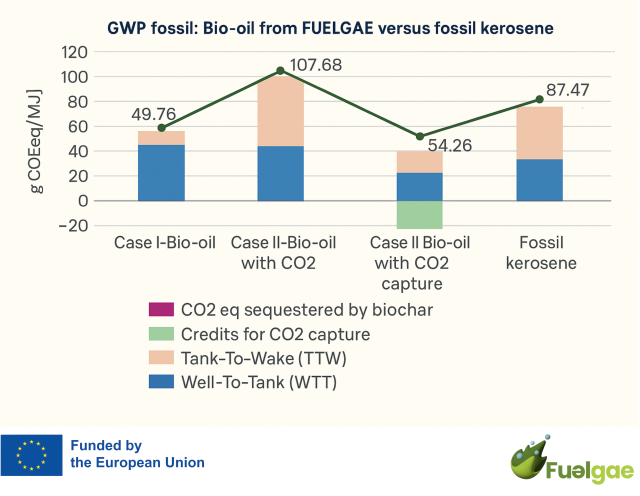
The preliminary results obtained at month 30 of the project are indicated in the figure below, which shows the comparison of the bio-oil obtained in Case I and Case II with their benchmark counterpart, in terms of GWP fossil. In Case I, the CO2 captured by microalgae originates from a biogenic source, whereas in Case II it comes from a fossil source.
In bio-oil from Case I, fossil CO2 emissions (expressed as CO2-eq) arise from the production process within the Well-to-Tank (WTT) stage, since combustion (TTW) releases the same biogenic CO2 previously captured by microalgae, which does not contribute to an increase in fossil GWP. As a result, the GWP fossil of Case I bio-oil is 49.76 g CO2 -eq/MJ. When compared with fossil kerosene with 87.47 g CO2-eq/MJ, this represents a 43% reduction in this impact category.
When analysing Case II, if the fossil CO2 captured by microalgae during their growth and subsequently released during combustion is included, the total net result of this category amounts to 54.26 g CO2-eq/MJ. When compared to fossil kerosene, this corresponds to a reduction of nearly 38% in the impacts.
The next steps of the project towards its conclusion at month 48 include, but are not limited to, optimization of biorefineries, sensitivity analysis using renewable energy scenarios, and hypothesis for the recovery of nutrients. For Deliverable 14.1, both LCA and LCC analyses will be adapted to the TRL 5 results achieved in the FUELGAE project, and a preliminary demo‑scale LCA will be carried out.
The Road Ahead for LCA in SAF Production
As the aviation industry strives for sustainability, LCA is becoming an indispensable tool for guiding the development of SAF. LCA provides the insight needed to identify environmental hotspots, optimize processes, and ensure that emissions reductions are genuine and measurable. Its role is crucial not only for evaluating current production methods but also for shaping future innovations and scaling up SAF technologies responsibly.
By continuously assessing the environmental impacts of each stage, from algae cultivation to fuel conversion and distribution, LCA helps stakeholders make informed decisions, minimize unintended consequences, and maximize overall sustainability.
Follow the FUELGAE journey, explore our progress, and join us in shaping a cleaner future for European aviation.
All images in the blog generated with support from Copilot M365.


