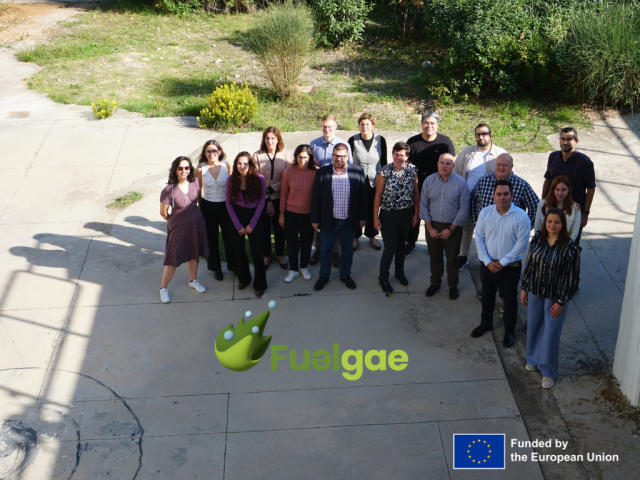
This year represented a major step forward for the FUELGAE project in its mission to develop sustainable biofuels from microalgae and reduce CO₂ emissions. As we bring this chapter to a close, we look back on the key achievements and milestones of 2025, which highlight strong collaboration, scientific innovation, and a shared commitment to delivering cleaner energy solutions for heavy industries such as aviation and shipping.
Main project advancements
- Microalgae cultivation:
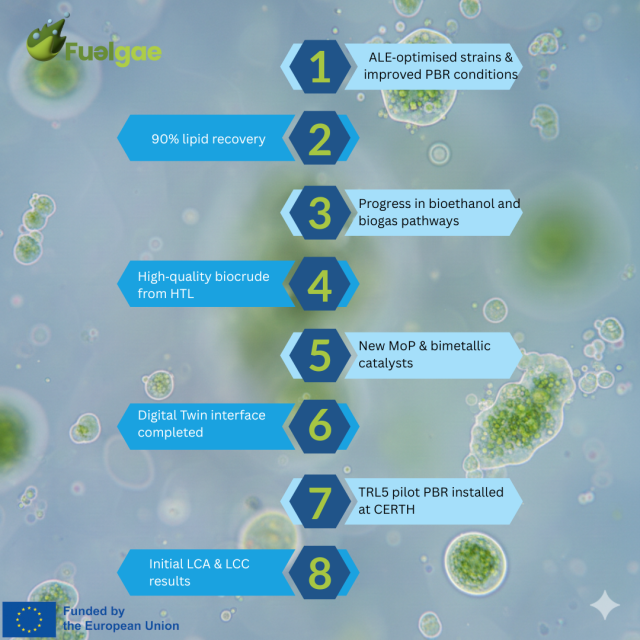
The consortium optimised ALE‑enhanced strains and refined photobioreactor conditions under CO₂‑rich industrial scenarios. These improvements increased polysaccharide and lipid productivity and are now prepared for pilot‑scale validation. - Biomass fractionation:
The team achieved over 90% lipid recovery using a biphasic organosolv process. Current work focuses on improving carbohydrate recovery to support downstream bioenergy pathways. - Bioethanol and biogas production:
Partners advanced hydrolysis, fermentation, and anaerobic digestion for both whole and fractionated biomass, supported by trials with commercial feedstocks and detailed characterisation. - Hydrothermal liquefaction and biochar valorisation:
HTL trials produced biocrude with high carbon content and strong energy value, confirming the potential of microalgae‑based feedstocks for advanced fuels. - Catalyst development:
Researchers developed promising MoP‑ and bimetallic‑based HDO catalysts to upgrade lipids and biocrude. The next phase will test catalyst stability under realistic biocrude conditions. - Process monitoring and Digital Twin:
The Digital Twin advanced through detailed CFD and plant‑wide modelling. Real‑time PAT systems were integrated, and the full user interface for process visualisation is now completed. - Scale‑up:
CERTH established a modular TRL5 photobioreactor for CO₂‑enriched cultivation, with industrial deployment planned in Valencia. CSIC catalysts will be used for the fuel upgrading stage. - Project impact and assessment:
Initial LCA and LCC for a 5,000 m³/year production scenario are complete, guiding both environmental and economic optimisation of the FUELGAE processes.
Project Dissemination
FUELGAE highlighted its accomplishments at major scientific events, such as the 33rd EUBCE – European Biomass Conference and Exhibition, the LCM 2025- 12th International Conference on Life Cycle Management, the AlgaEurope 2025, the European Researcher’s Night, SECAT 2025 and many more.
The project’s dissemination strategy has made significant strides with the release of two peer-reviewed publications, both of which are accessible through open science platforms.
- CERTH published “Screening Microalgae for Producing Biofuel Precursors from Industrial Off-Gases”
- CSIC contributed “Efficient Hydrodeoxygenation of Used Cooking Oil Using Molybdenum Phosphide on Silica Supports for Sustainable Green Fuel Production”.
These publications not only highlight the innovative efforts of the consortium but also reinforce their dedication to advancing scientific knowledge and ensuring that these advancements are accessible to a wider audience.
Additionally, the SUSTAFUELS Cluster has grown with the addition of new initiatives aimed at accelerating the development and large-scale deployment of sustainable transport fuels. The expanded cluster now brings together ten pioneering Horizon Europe projects (ALFAFUELS, ALGAESOL, CAPTUS, COCPIT, FUELGAE, ICARUS, NIAGARA, SusAlgaeFuel, SUNFUSION, and SUSTEPS) all united by a shared ambition: to drive the transition towards a decarbonised transport sector powered by renewable, bio-based fuels.
Looking Ahead
As we begin 2026, FUELGAE enters a decisive phase, moving from laboratory optimisation towards pilot‑scale validation and real‑world integration. The consortium remains committed to demonstrating how microalgae‑based biorefineries can contribute to Europe’s climate‑neutrality goals.
We look forward to another productive year of collaboration and scientific progress.
Stay updated through our newsletter and at https://www.fuelgae.eu