


Aviation’s Big Turning Point
Aviation has always symbolised connection—linking people, ideas, and markets across continents. Yet behind this global mobility lies a difficult reality: the industry still depends almost entirely on fossil jet fuel. In 2018, aviation was responsible for 2.4% of global CO₂ emissions, and its contribution to climate impact extends beyond CO₂ alone. As passenger demand continues to rise, the challenge becomes clear: decarbonising aviation is not optional; it is imperative.
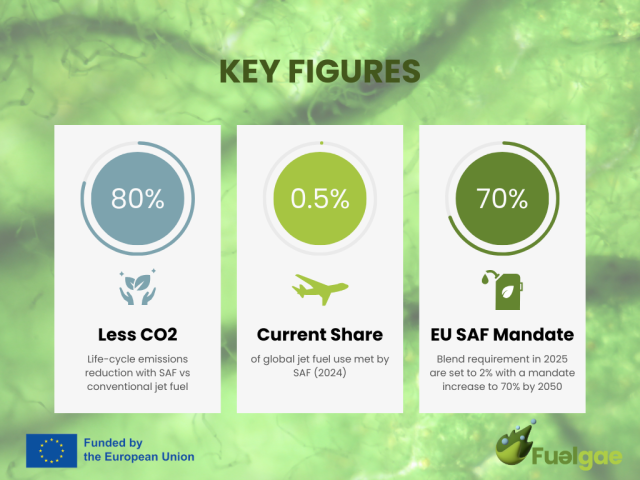
Europe has recognised this urgency. Rather than waiting for revolutionary aircraft designs or long‑term propulsion technologies, it has placed its bets on a solution that can be deployed now: sustainable aviation fuel (SAF). With the ReFuelEU Aviation regulation, adopted as part of the Fit for 55 package, the EU is laying out a clear path—from 2% SAF in 2025 all the way to 70% by 2050. These targets send one unified message: the age of fossil-only jet fuel is ending.
What Exactly Counts as SAF?
SAF is not just any alternative to kerosene. Under ReFuelEU Aviation, four categories qualify:
- Biofuels from oils and fats
- Advanced biofuels from residues and wastes — including microalgae, the focus of the FUELGAE project
- Synthetic fuels (efuels) made using green hydrogen and captured CO₂
- Recycled carbon fuels derived from nonrenewable waste streams
Despite their varied origins, all SAF types share one crucial feature: they are refined into hydrocarbons that behave just like conventional kerosene, offering equal safety, energy content, and engine performance. In other words, no new aircraft technology is required — a massive advantage when fleets remain in service for decades.
Why SAF is a Cornerstone of Aviation’s Climate Strategy
One of the greatest strengths of SAF is its potential to immediately slash emissions. Depending on the pathway, SAF can reduce lifecycle CO₂ emissions by 50–80%. In the case of synthetic fuels made from captured CO₂ and green hydrogen, reductions can be even greater—and potentially approach carbon neutrality. In some advanced concepts, the process could even lead to net‑negative emissions if the CO₂ used comes from direct air capture.
But the benefits do not stop at carbon. SAF typically contains fewer impurities than fossil jet fuel, meaning fewer soot particles and potentially lower formation of contrails—an often overlooked but significant contributor to aviation’s warming effect. This makes SAF uniquely positioned to reduce not only CO₂ but also non‑CO₂ climate impacts.
Critically, SAF is what the industry calls a “drop‑in” fuel. It can be blended with conventional fuel and used in existing aircraft and airport infrastructure. This bypasses the decades-long waiting period that would be required to transition global fleets to new propulsion systems. SAF allows climate action today, without grounding planes or redesigning engines.
Where the World Stands on SAF Today
Despite its advantages, SAF is still in its infancy. In 2024, global SAF production reached only about 1.5 million tonnes—roughly 0.5% of global jet fuel demand. More than 99% of aviation fuel burned worldwide remains fossil-based. Scaling up is therefore both the greatest challenge and the greatest opportunity. Europe, however, is moving quickly. Early implementation of ReFuelEU shows increasing adoption, with approximately 0.6% SAF used in EU airports in 2024. These early blends come mostly from waste oils and fats, but new pathways are emerging.
Major airlines—including KLM, Lufthansa, Air France, and British Airways—have operated dozens of flights using SAF blends of 10–50%, demonstrating real‑world reliability. On the manufacturing side, Airbus has successfully flown an A380 using 100% SAF in one of its engines, proving the technical viability of high-concentration blends. These demonstrations pave the way toward future certification of 100% SAF flights.
However, meeting demand requires major expansion. The EU estimates that roughly 100 new SAF production plants will be needed by 2050. To accelerate this build‑out, the EU and member states have launched significant funding programmes, from the Sustainable Transport Investment Plan (STIP) to Innovation Fund grants and dedicated auctions for e‑fuel production. The Emissions Trading Scheme (ETS) has also been updated to reward airlines for using certified SAF, helping offset its higher cost.

FUELGAE: Turning Microalgae Into High-Quality Jet Fuel
Among the most innovative SAF pathways is microalgae—a feedstock that does not compete with agriculture, grows rapidly, and can be cultivated using CO₂ from industrial sources. The FUELGAE project, funded by Horizon Europe, aims to convert microalgae into high‑quality SAF that meets strict aviation performance standards while significantly lowering lifecycle emissions.
Microalgae offer a compelling set of advantages:
- They grow using sunlight, CO₂, and nutrient-rich water.
- They can be produced in Europe, reducing dependence on imported fossil fuels.
- They can reach higher yields per hectare compared to terrestrial biomass.
- They do not require land, avoiding competition with food production.
The project does more than fuel production. FUELGAE helps build a network of researchers, engineers, and industry partners working together on scalable and economically viable SAF solutions. Its work contributes to EU climate policies and supports compliance mechanisms such as the ETS, making microalgae‑derived SAF attractive for future airlines seeking to meet regulatory targets cost‑effectively.
A European Ecosystem of Innovation
FUELGAE is part of a broader European movement. Research initiatives such as ALFAFUELS and COCPIT complement each other, creating a pan‑European innovation ecosystem. Together, these projects aim to ensure that next‑generation SAF technologies can reach commercial maturity, diversify feedstocks, and reduce risk for investors.
Through Horizon Europe and national funding programmes, Europe is nurturing the breakthroughs needed to decarbonise aviation at scale. Whether through microalgae, agricultural residues, municipal waste, or synthetic fuels powered by renewable electricity, the goal is the same: create a resilient, sustainable, and secure energy system for the skies.
The Road Ahead
As Europe progresses toward its climate goals, the role of SAF grows increasingly central. It offers immediate emissions reductions, long-term scalability, and compatibility with existing infrastructure. But its potential can only be realised through continued investment, innovation, and collaboration.
Projects like FUELGAE demonstrate how scientific excellence, industrial expertise, and strong policy frameworks can converge to transform ambitious climate objectives into practical, real‑world solutions. The journey toward climate‑neutral aviation has begun—and SAF is at its heart.
Follow the FUELGAE journey, explore our progress, and join us in shaping a cleaner future for European aviation.


