


The 13th International Conference on Sustainable Solid Waste Management (KOS 2026) successfully brought together researchers, industry leaders, policy makers, local authorities, innovators and sustainability experts from around the world on the island of Kos, Greece. The conference is a major international platform for exchanging knowledge and showcasing practical solutions for waste management, circular economy, resource recovery and sustainable biofuels. It is organised yearly by the Unit of Environmental Science and Technology of the National Technical University of Athens, a partner in the FUELGAE project.
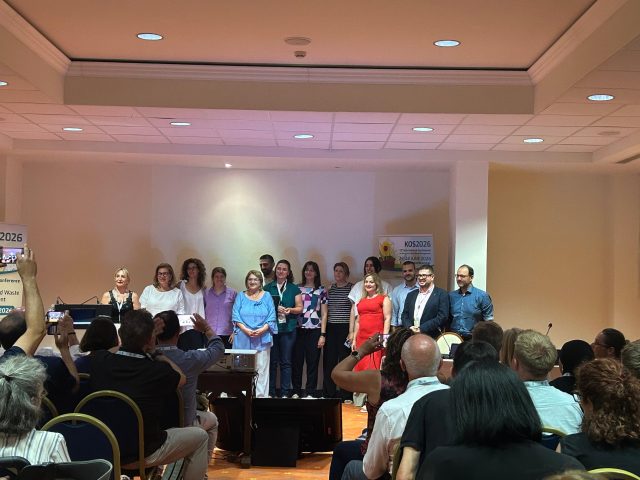
The organising team from UEST at NTUA. (c) RTDS 2026.
Participants explored innovative approaches to turn waste into valuable resources, reduce greenhouse gas emissions and accelerate the transition towards a climate-neutral and circular economy. The conference covered a wide range of topics including recycling, biowaste valorisation, waste-to-energy technologies, circular economy, carbon capture, sustainable aviation fuels, hydrogen technologies and advanced bio-based solutions.
Impressive Participation and International Reach
KOS 2026 once again confirmed its status as one of the leading international conferences in the field of sustainable waste management. The outstanding engagement of the international community demonstrates the growing importance of collaboration in addressing global environmental and resource challenges.
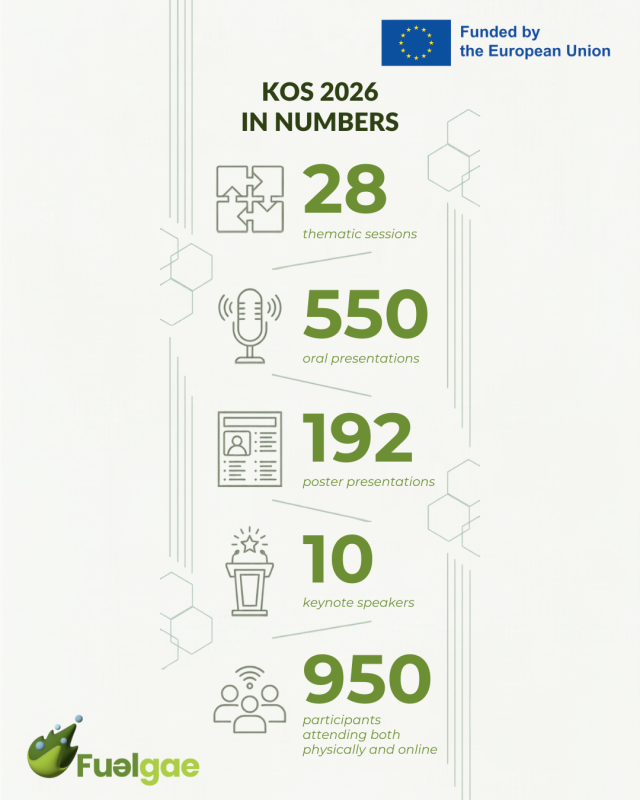
Conference statistics. (c) RTDS Group 2026.
Following the success of KOS 2026, the international community will meet again at 14th International Conference on Sustainable Solid Waste Management (KALAMATA 2027), 23–26 June 2027 to continue the discussion, share new results and strengthen collaborations that will help accelerate the transition towards a circular, climate-neutral and resource-efficient Europe.
Shaping the Future of Carbon Circularity and SAF in Europe
One of the highlights of the conference programme was the dedicated Horizon Europe FUELGAE Workshop, entitled: “Closing the Carbon Loop: Converting CO₂ and Waste Streams into Scalable, Zero-Waste Advanced Fuels“. The workshop showcased how innovative microalgae-based technologies can capture CO₂ from industrial sources and convert it into sustainable advanced biofuels. The session presented cutting-edge research and pilot-scale developments aimed at supporting the decarbonisation of the heavy-transport sector, particularly aviation and other hard-to-abate industries. Participants learned about:
- Innovative microalgae cultivation technologies
- Advanced photobioreactor systems
- Digital monitoring and optimisation tools
- Sustainable conversion pathways from microalgae to advanced liquid fuels
- Environmental life-cycle assessments of biofuel production
- Future opportunities for industrial deployment and scale-up of biofuel technologies
The workshop clearly demonstrated the potential of microalgae to become an important part of Europe’s sustainable energy future.
Strong Synergies with European Research Projects
The FUELGAE workshop also featured presentations from several complementary European initiatives working towards sustainable fuel production and carbon reduction.
CRONUS: Negative-Emission Sustainable Biofuels
Dimitris Malamis (NTUA, EL) presented the capture and reuse of biogenic gases for negative-emission sustainable biofuels on CRONUS project. The project is developing innovative solutions that transform biogenic carbon emissions into renewable fuels while contributing to climate mitigation goals.
ALGAESOL: Sustainable Fuels for Aviation and Shipping
Ylva Katarina Wedmark (NORCE, NO) introduced the ALGAESOL project and its work on producing sustainable aviation and shipping fuels using microalgae and solar-based technologies. The project aims to support the decarbonisation of sectors where reducing emissions remains particularly challenging.
ICARUS: International Cooperation for Sustainable Aviation Biofuels
The workshop also welcomed the ICARUS project, which promotes international cooperation and knowledge exchange for the deployment of sustainable aviation biofuels. Loukas Gavriil (CRES, EL) highlights the importance of collaboration across countries and regions to accelerate the uptake of cleaner aviation technologies.
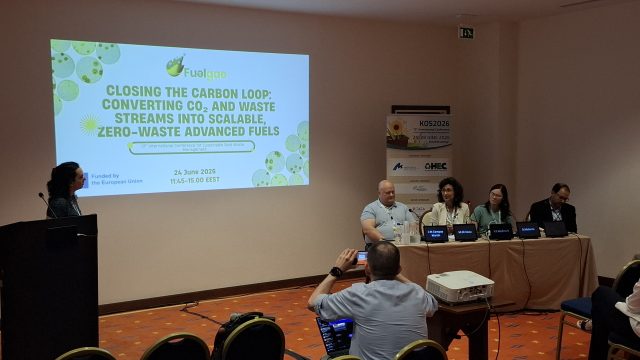
(c) RTDS Group 2026
From Research to Impact: Expert Panel Discusses the Future of SAF in Europe
The FUELGAE workshop concluded with a panel discussion involving representatives from the projects FUELGAE, CRONUS, ICARUS and ALGAESOL, who explored the policy, technological and market challenges associated with scaling up advanced sustainable fuels in Europe. The discussion reinforced the importance of continued cooperation between research projects, industry, policy makers and investors to accelerate the deployment of sustainable fuel technologies and support Europe’s transition to a climate-neutral economy.
The panel focused on:
- Opportunities and challenges in converting CO₂ and waste streams into scalable, zero-waste advanced fuels.
- Policy incentives and regulatory measures to support the decarbonisation of aviation.
- How European policies can better support the utilisation of biogenic gases and strengthen links between the biofuel, energy and transport sectors to create carbon-negative fuel value chains.
- Europe’s position in the global advanced fuels market and the actions needed to strengthen its competitiveness and leadership.
- The adequacy of existing sustainability assessment, certification and Life Cycle Assessment (LCA) methodologies for integrating algae-based fuels into Sustainable Aviation Fuel (SAF) frameworks.
Projects such as FUELGAE, CRONUS, ALGAESOL and ICARUS show how circular economy approaches can connect renewable energy, carbon capture and sustainable transport fuels. By turning waste streams and carbon emissions into valuable resources, they support Europe’s climate and sustainability goals.
Looking Ahead
The participating projects agreed to develop a joint Policy Brief, which will summarise the key recommendations and messages emerging from the discussion. The document will provide evidence-based insights and guidance for policy makers, industry stakeholders and funding bodies on the future development of advanced sustainable fuels, carbon capture utilisation and circular carbon value chains across Europe.
To further support knowledge sharing and stakeholder engagement, the presentations delivered during the workshop are made publicly available through the FUELGAE Zenodo Community, enabling researchers, industry representatives, policy makers and interested citizens to access the latest project results and technological developments.


