


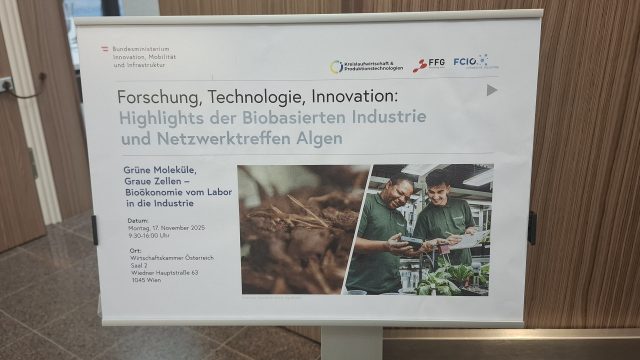
On the 17th of November, FUELGAE participated at the “Highlights of the bio-based industry” in Vienna.
The event was hosted in Austrian Federal Economic Chamber, gathering more than 80 key Austrian stakeholders in the dynamic fields of biorefineries and the innovative use of renewable raw materials. This year’s highlights from the bio-based industries showcased just how rapidly bioeconomy research and its applications are advancing. Together with the Austrian Federal Ministry for Innovation, Mobility and Infrastructure (BMIMI), the Austrian Association of the Chemical Industry (FCIO) and Austrian Society for Environment and Technology (ÖGUT), the latest projects, business models and technological approaches were presented along with the successful integration of the Algae Network Meeting into the event for the first time.
Moving Bioeconomy from the Lab to Industry
Innovative solutions emerge at the intersection of research, industry expertise, and visionary thinking. The event highlighted how leading researchers and industry partners are jointly developing new pathways toward a bio-based and circular economy, transforming concepts into tangible materials, experiments into validated prototypes, and innovations into market-ready applications.
The scope and maturity of current bio-based developments were showcased through compelling project presentations, ranging from recyclable bio-composites and next-generation fertilizers to advanced algae-based technologies. Alongside keynote insights and strategic panel discussions, the event offered extensive opportunities for professional exchange and networking through interactive sessions.
Keynotes: Nature as a Technology Role Model – and Economics as a Catalyst
The keynote presentations emphasized the close interconnection between natural functional principles and economic incentives for a successful bioeconomy. Ille Gebeshuber illustrated, through compelling examples from biomimetics, that nature, with its 3.5 billion years of “research experience,” provides solutions focused on circularity and structural efficiency, rather than material consumption. While 100 gigatons of primary materials are used annually, nature inherently considers biodegradability and multifunctionality from the outset.
Thomas Jakl expanded on this perspective by introducing the economic dimension: the bio-based industry can only realize its full potential when business models reward resource efficiency. For instance, when a manufacturer is paid per usage rather than per unit produced. The use of plant residuals, he explained, highlights the importance of not only utilizing the energy value but also the informational and structural properties of biological resources.
Collaborative Progress Across Research, Industry, and Policy
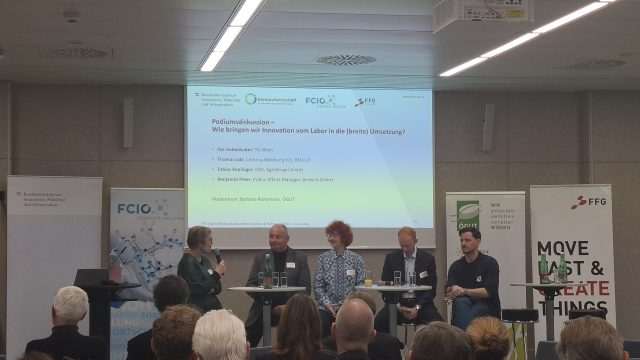
The panel discussion emphasized that progress can only be achieved through the collaboration of research, industry, and government, and that Austria and Europe can maintain their competitiveness primarily through innovation. Far-reaching, internationally harmonized regulations and clear mandates, such as compulsory recycled content were identified as key drivers of the transformation. From the perspective of startups, the importance of scalability was underscored: the critical factor is not the laboratory scale, but rather the proof that bio-based processes can function on an industrial scale. It was also made clear that bio-based products will only succeed if they can compete with synthetic alternatives on price.
Project Diversity and Intensive Knowledge Exchange
Parallel sessions presented projects from the bio-based industries and algae research-ranging from bio-based thermosets and innovative fertilizers to new biorefinery products, microalgae-based materials and LED-supported biosynthesis.
In the afternoon, an interactive World Café offered space for dialogue on European and national funding opportunities, “Sustainable by Design,” innovative material substitution, education and training needs.
Conclusion
The event once again demonstrated how dynamic, diverse and economically relevant the bio-based industry has become. It unites scientific excellence, technological progress and entrepreneurial innovation-opening up new perspectives for a circular, resource-efficient future.
FUELGAE booth at the Highlights of the bio-based industry
FUELGAE communication lead RTDS Association further represented the project with an exhibition booth. The FUELGAE booth showcased key project materials, including the flyer, the roll-up banner and the project animation. The FUELGAE responsible for project communication, RTDS Association, informed stakeholders attending the event about recent progress made in the project. RTDS also outlined the next steps for FUELGAE for the upcoming years.

For more information about the event: Highlights der Biobasierten Industrie 2025 – Innovationen aus Forschung und Praxis


