


by Daniela Negruti
Producing more Sustainable Aviation Fuel (SAF) is often seen as the key to reducing aviation emissions. However, as highlighted in a recent webinar attended by FUELGAE, organised by the World Bioenergy Association (WBA) and Asia Sustainable Aviation Fuel Association (ASAFA), getting SAF from production facilities to aircraft is a far more complex challenge than it may appear. In this blog, we share some of the main takeaways from the discussion, highlighting the airport perspective.

Why SAF matters
SAF is an alternative to conventional jet fuel that is produced from sustainable feedstocks, such as waste oils, residues, biomass, or renewable synthetic fuels. Because it can significantly reduce greenhouse gas emissions across its lifecycle, SAF is considered one of the most important tools currently available for reducing aviation’s climate impact. Importantly, SAF can be used in existing aircraft and aviation infrastructure without requiring a new type of aircraft.
A recent factsheet by WBA and ASAFA underlines why SAF has become such a central topic in aviation sustainability discussions. Many industry roadmaps identify SAF as the single largest contributor to aviation’s decarbonisation efforts, potentially delivering 65-80% of the sector’s CO₂ reductions by 2050, as highlighted in the factsheet. Yet despite growing policy support and market demand, production remains limited. In 2024, global SAF output was only about 1 million tonnes, compared with an annual jet fuel demand of roughly 300 million tonnes, illustrating the scale of the challenge ahead (World Bioenergy Association, 2026).
This topic is closely connected to FUELGAE’s work. The project aims to develop a novel model for producing advanced liquid biofuels from microalgae grown in different CO₂ emission streams generated by biorefineries and energy-intensive industries. By exploring innovative pathways for sustainable fuel production, FUELGAE contributes to the broader effort of creating lower-carbon solutions for the aviation and heavy transport sector.
Airports as Enablers of SAF Deployment
Producing SAF is only part of the challenge. For SAF to be used by an aircraft, it first needs to reach the airport, enter the airport’s fuel infrastructure, and be delivered through the fuel supply system to the airline and, ultimately, the aircraft. Therefore, SAF suppliers need access to airport infrastructure and fuel distribution systems before they can deliver the fuel. As a result, market access can become a significant barrier to SAF deployment.
Although airports do not produce or purchase fuels, and neither do they make airline fuel procurement decisions, they sit at the heart of the aviation ecosystem and provide the infrastructure that allows aircraft operations to take place.
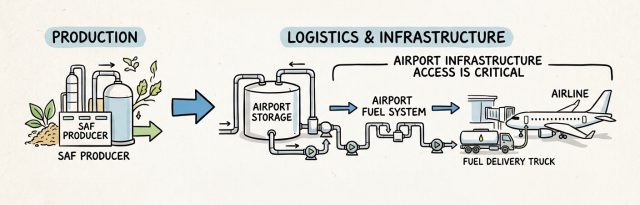
How SAF becomes available to airlines and reaches the aircraft. Source: Gemini AI generated image
Airports are where SAF becomes available to airlines. They can support SAF deployment through:
- Demand aggregation from all various stakeholders.
- Market dialogue between fuel suppliers and airlines.
- Coordination and support to secure market access for new SAF suppliers.
- Creating partnerships across the aviation value chain.
At the same time, many factors affecting SAF deployment depend on collaboration across the value chain, such as:
- Fuel infrastructure, storage, and distribution.
- Physical fuel logistics and supply arrangements.
- Access to opportunities for new fuel suppliers.
As an example of an existing bottleneck, let us consider fuel supply contracts, that often last many years (e.g. 5-15 years). If existing suppliers do not offer SAF products, new suppliers may find it difficult to enter the market even when sustainable fuel is available. This showcases why coordination between airports, airlines and fuel companies is so important.
Looking ahead
The transition to sustainable aviation requires coordinated efforts from airports, airlines, fuel producers, policymakers, researchers, and technology developers.
While airports cannot control fuel production or purchasing decisions, they can create the conditions that make SAF deployment easier through coordination, partnerships, and demand aggregation. As regulations such as CORSIA and ReFuelEU Aviation accelerate demand for sustainable fuels, this enabling role will become increasingly important.
Projects such as FUELGAE can contribute to this transition by supporting research, innovation, knowledge exchange, and stakeholder collaboration. By helping to develop sustainable fuel solutions and fostering dialogue across sectors, FUELGAE is supporting the journey towards a more sustainable aviation industry.
Read more about SAF and EU’s ReFuelEU Aviation Regulation in this previous blog from FUELGAE.
Interested in learning more? Read this factsheet from WBA and ASAFA for a concise overview of SAF production pathways, relevant policy frameworks across the world, and the gap between SAF supply and the levels needed to achieve net-zero aviation.


