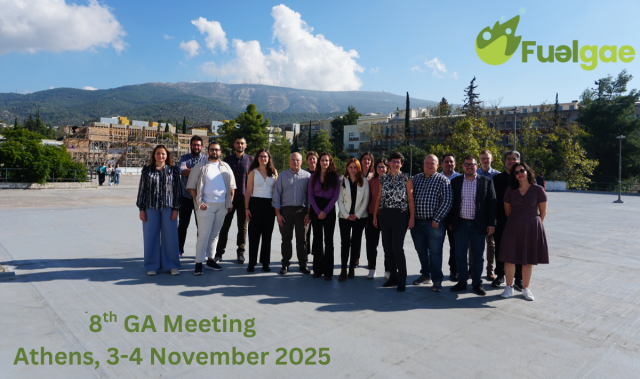
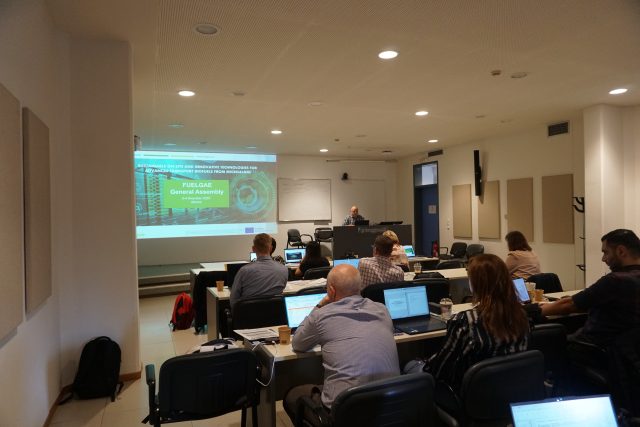
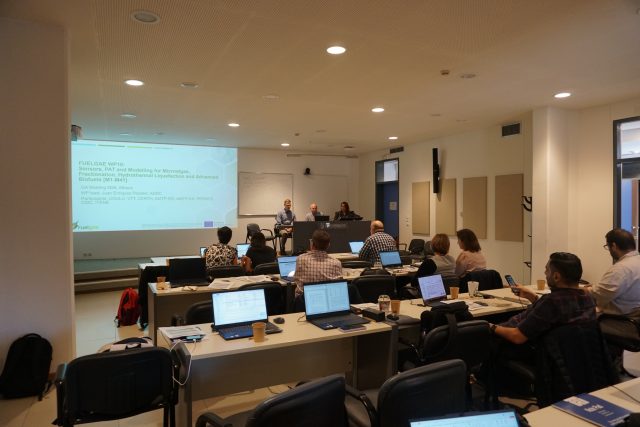
The FUELGAE consortium has successfully concluded its 8th General Assembly meeting, held on 3–4 November 2025 in Athens, Greece. Hosted by the National Technical University of Athens (NTUA) and coordinated by the Spanish National Research Council (CSIC), the meeting marked a major milestone: the completion of the first 24 months of this Horizon Europe–funded project.
With partners presenting strong scientific and technological progress, the consortium reaffirmed that the project is well on track to validate a breakthrough biorefinery model for producing Advanced Liquid Biofuels (ALBs) from industrial CO₂ emissions. From optimised microalgae cultivation and innovative fractionation methods to catalytic conversion technologies and the development of an integrated Digital Twin, the project is advancing toward its ambition of enabling a circular, low-carbon bioeconomy in Europe.
Advancing the Core Bioprocess: From CO₂ to Valuable Biomass
Optimising Microalgae Cultivation
Partners highlighted significant achievements in microalgae strain development and cultivation. Building on early screening and Adaptive Laboratory Evolution (ALE), the team has focused on refining cultivation protocols using bench-scale tubular photobioreactors (PBRs) under conditions that closely mimic the CO₂-rich environments of the project’s two case studies-a bioethanol plant in Spain and a steel plant in Romania.
Using advanced Design of Experiments (DoE) approaches, the researchers successfully identified optimal operational windows. Key parameters such as light colour, CO₂ concentration, and nutrient availability were evaluated to maximise the production of targeted compounds, including polysaccharides and lipids. Work in the coming months will involve validating these protocols with ALE-enhanced strains and preparing for scale-up in the pilot PBR. Several scientific contributions have already been presented at leading international conferences, enhancing the project’s visibility within the research community.
Novel Fractionation Methods for Microalgal Biomass
Work Package 6 has made equally impressive progress in developing innovative fractionation processes. Early trials of a biphasic organosolv method yielded excellent results, particularly in lipid recovery. Experiments with Chlorella microalgae achieved over 90% lipid extraction-meeting and surpassing key performance indicators. Using 2-MTHF as the organic solvent and oxalic acid as the catalyst proved especially effective.
The team now aims to improve carbohydrate recovery, which will be critical for the downstream bioethanol and biogas processes explored in later work packages.
Transforming Biomass into Advanced Liquid Fuels
Integrated Bioethanol and Biogas Production
Work Package 7 is defining the most efficient routes for converting microalgal fractions into bioethanol and biogas. PERSEO is optimising enzymatic hydrolysis and fermentation using both whole-cell microalgae and the polysaccharide-rich fractions derived from WP6. To overcome current biomass limitations, trials have begun using commercially sourced microalgae, with direct comparisons underway between whole cells and fractionated material.
ITENE is advancing biogas production studies, assessing digestion performance using whole-cell biomass as well as residues obtained from the fractionation process. Detailed characterisation of feedstocks is enabling more accurate lab-scale digestion experiments.
Hydrothermal Liquefaction and Biochar Valorisation
In Work Package 9, partners are transforming the remaining biogenic residues into high-value products through hydrothermal liquefaction (HTL). Preliminary tests with Chlorella vulgaris have produced biocrude with promising properties, including high carbon content and strong heating value.
In parallel, NTUA is preparing greenhouse trials to evaluate the agronomic potential of the resulting biochar on both acidic and basic soils. These tests will help validate the biochar’s benefits for soil health and its capacity for long-term carbon sequestration-supporting the project’s zero-waste approach.
Innovative Monitoring and Digital Twin Development
Advanced Catalysts for Biofuel Conversion
CSIC reported notable progress in catalyst development for hydrodeoxygenation (HDO), the critical final step in converting lipids and biocrude into advanced liquid fuels. The best-performing candidates to date include MoP/SiO₂ catalysts produced via the phosphite method and bimetallic MoNiP/SiO₂ and MoCoP/SiO₂ catalysts. Upcoming work will involve intensive stability testing and evaluation using nitrogen-containing model compounds to replicate real biocrude compositions more accurately.
Digital Twin & Process Analytical Technology Integration
The Digital Twin (DT), a central innovation of the project, has advanced significantly. Detailed CFD models for the PBR and HTL systems are progressing, with simulations showing that smaller bubbles greatly enhance gas–liquid mass transfer in PBRs. Plant-wide models incorporating dynamic simulations, kinetic studies, and Aspen Plus modelling for lipid extraction are also being developed.
On the monitoring side, the advanced Time-Gated Raman and microscope-based PAT systems developed by VTT have been delivered to CERTH for real-time integration with the pilot PBR. The Digital Twin Graphical User Interface is now complete, enabling users to visualise mass flows, energy consumption, and concentration profiles for both industrial case studies.
Pilot Scale-Up and Validation Under Industrial Conditions
Work Package 12 marks the transition to Technology Readiness Level 5 (TRL5), demonstrating the FUELGAE concept in industrially relevant environments. The modular airlift PBR, equipped with advanced sensors, is currently being commissioned at CERTH under CO₂-enriched conditions.
In late 2026, the system will be transported to the bioethanol plant in Valencia, where the polysaccharide-producing strain will be cultivated using on-site CO₂-rich off-gases. Lipids and biocrude produced will undergo catalytic HDO at CERTH’s pilot hydroprocessing unit using CSIC-developed catalysts. To ensure continuity across all validation tasks, partners agreed to supplement project-grown biomass with commercially sourced material if needed.
Sustainability, Impact Assessment, and Next Steps
Work Package 13 presented the first Life Cycle Assessment (LCA) and Life Cycle Costing (LCC) results for both industrial case studies, assuming a future production capacity of 5,000 m³ per year. These analyses will guide process optimisation by identifying environmental hotspots and assessing economic feasibility.
In the months ahead, the consortium will focus on completing laboratory optimisations, finalising scale-up designs, and beginning the integration of advanced monitoring tools at the pilot sites. As the project moves toward industrial validation, FUELGAE continues to demonstrate how microalgae-based biorefineries can contribute to Europe’s transition toward climate neutrality.
Getting Ready for 2026
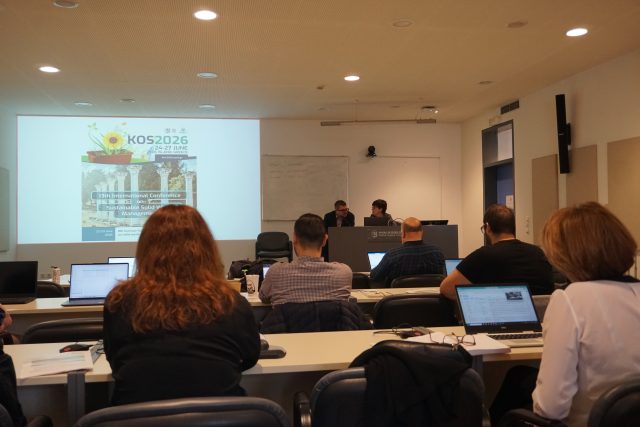
As the scientific and technological process is on track, so are the dissemination activities. FUELGAE will have a dedicated workshop at the 13th International Conference on Sustainable Solid Waste Management taking place on Kos Island, Greece, 24-27 June 2026. We will also be present with several contributions at EUBCE in The Hague, The Netherlands, 19-22 May 2026. Finally, our coordinator Silvia Morales is part of the organising committee for CCESC26 taking place in Madrid, Spain, 28-30 September 2026.